
اس آرٹیکل کو اردو میں پڑھنے کیلئے کلک کریں
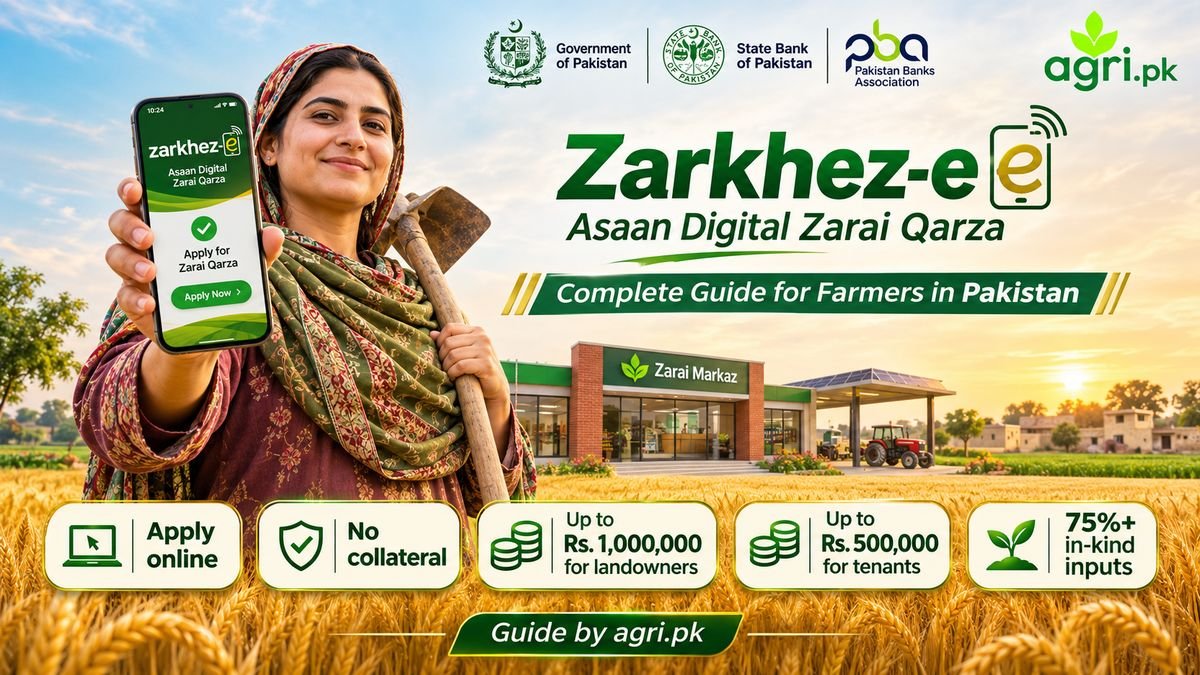
Zarkhez-e, with the tagline Asaan Digital Zarai Qarza, is a digital agricultural financing scheme for small and subsistence farmers in Pakistan. It is an initiative of the Government of Pakistan and the State Bank of Pakistan, run with banks and microfinance banks, and it is designed so that a farmer can apply online without visiting a bank branch and without putting up collateral.
In simple words, it is a short-term crop loan, given mostly not as cash but as inputs — seeds, fertilisers, pesticides and diesel — bought through merchants approved by the banks. That in-kind design is deliberate: the money is meant to go into the crop, not somewhere else.
Key Features of Zarkhez-e
- Target audience: Small and subsistence-level farmers and tenants across Pakistan.
- Financing limits: Up to Rs. 100,000 per acre; maximum Rs. 1,000,000 for landowners, Rs. 500,000 for tenant farmers.
- Disbursement: At least 75% in-kind (seeds, fertilisers, pesticides, diesel via approved merchants); cash up to 25% for landowners, up to 15% for tenants.
- Tenure and repayment: Up to 12 months, bullet repayment of principal plus markup at the end of the term.
- Fee: Rs. 1,200 processing fee, paid through the portal.
- Insurance: Group life insurance equivalent to the loan amount disbursed and outstanding.
- Digital application: Apply online via the portal/app, no branch visit and no collateral required.
What is Zarkhez-e, in one paragraph
Zarkhez-e was earlier called the National Subsistence Farmers Support Initiative, and was renamed Zarkhez-e for farmers to remember and use easily. Applications come in through a central online portal and mobile app, are checked and assessed — including verification and an agronomic assessment through the Land Information Management System — and are then forwarded to the bank chosen by the applicant for processing and approval.
It is not a grant, and it is not interest-free. It is a loan with markup, repaid at the end of the term, and the markup rate depends on the bank you choose. Always check the rate for your chosen bank on the portal before you apply, because a rate quoted for one bank does not apply to another.
How much can you get
- Landowners: For landowners, the limit is up to Rs. 100,000 per acre, up to a maximum of Rs. 1,000,000.
- Tenant farmers: For tenant farmers, the limit is also up to Rs. 100,000 per acre, but up to a maximum of Rs. 500,000.
- 5-acre example: In practice, that means a landowner with 5 acres could be eligible for up to Rs. 500,000.
- 10-acre example: A landowner with 10 acres or more reaches the Rs. 1,000,000 ceiling.
- Tenant ceiling: A tenant’s ceiling is reached sooner, at 5 acres, because of the lower maximum.
- Maximum is not a guarantee: Your actual approved amount will still depend on verification, the agronomic assessment, and the bank’s decision — the maximum is not a guarantee.
How the money is given: mostly in-kind, some in cash
- In-kind share: At least 75 percent of the financing is disbursed in-kind. That means you buy approved inputs — seeds, fertilisers, pesticides and diesel — from reputable merchants on-boarded by the banks, through digital channels, rather than receiving the full amount in cash.
- Cash shares: The cash part is limited: up to 25 percent in cash for landowners, and up to 15 percent in cash for tenants, for other farming expenses.
- Islamic banks: Islamic banks follow their own Shariah-compliant modes for the same structure.
- Plan ahead: This is the part many applicants miss. If you were expecting the full loan in cash, plan your season around the in-kind share instead: choose your inputs, your merchant, and your timing in advance, so the in-kind limit is actually useful when the crop needs it.
Who can apply
- Who it is for: The scheme is for subsistence-level farmers across Pakistan, both landowners and tenants.
- Land limits by province: The land limits in the State Bank’s term sheet are: up to 12.5 acres in Punjab and Khyber Pakhtunkhwa, up to 16 acres in Sindh, and up to 32 acres in Balochistan.
- CNIC, SIM and e-CIB: You will need a valid, NADRA-verified CNIC and a mobile SIM in your own name, and a clean e-CIB record.
- Age 21 to 60: Published summaries of the term sheet put the age range at 21 to 60 years — if the portal shows a different age limit when you apply, follow the portal, because scheme details can be updated.
- Above the limit: If your landholding is above the limit for your province, or your e-CIB record is not clean, this scheme is not the right route, and a bank branch can advise you on other agricultural financing options instead.
Tenure, repayment, fee and insurance
- Tenure and bullet repayment: The financing tenure is up to 12 months. Principal plus markup is repaid at the end of the term, as a bullet repayment, rather than in monthly instalments. That matches a crop cycle, but it also means you must plan for one larger repayment at harvest time, not small monthly payments.
- Rs. 1,200 fee — warning: There is a processing fee of Rs. 1,200, paid through the online portal to cover verification costs, including NADRA, land records and related checks. Be wary of anyone asking for a larger “registration” or “approval” fee outside the portal — that is not part of the official process described in the term sheet.
- Insurance: Loans under the scheme are also covered by group life insurance, equivalent to the loan amount disbursed and outstanding. Ask your chosen bank to explain, in writing, exactly what that cover includes before you sign.
How to apply, step by step
- Step 1 — Official portal or app: Go to the official Zarkhez-e portal or app — not to a copycat page or a WhatsApp link sent by an unknown number. Register with your CNIC and your own mobile number, and complete the verification steps the portal asks for.
- Step 2 — Land and crop details: Fill in your land and crop details honestly. The system will check them against land records and carry out an agronomic assessment. Wrong land or crop details will slow the application down, or get it rejected.
- Step 3 — Choose your bank: Choose your bank on the portal. Applications are forwarded to the bank you choose, and that bank processes and approves the loan. Banks and microfinance banks participate through the scheme, and the list on the portal is the current list to use — do not rely on an old list from social media.
- Step 4 — Pay the Rs. 1,200 fee: Pay the Rs. 1,200 processing fee through the portal, using the payment slip (PSID) it generates. Keep that receipt safe.
- Step 5 — Use the loan as intended: Once approved, use the in-kind share only at approved merchants for seeds, fertilisers, pesticides and diesel, and use the small cash share only for genuine farming expenses. Keep every merchant receipt, because that is your record if there is ever a question about how the loan was used.
If you need help with digital onboarding, the scheme’s own guidance says you can also visit your nearest bank branch for assistance — that is a safer route than handing your CNIC and phone to a stranger who offers to “apply for you” for a fee.
Watch this step-by-step video guide to applying through the app:
Video credit: the original uploader on YouTube. This video is embedded for readers’ convenience and is not owned by agri.pk. It will be removed promptly on the owner’s request.
Landowner or tenant: what to decide before you apply
- Landowner vs tenant ceilings and cash shares: Before you start, be clear about your own position, because it changes your maximum and your cash share. Are you applying as a landowner, with land in your name, or as a tenant farmer cultivating someone else’s land? Your answer decides whether your ceiling is Rs. 1,000,000 or Rs. 500,000, and whether your cash share can go up to 25 percent or only 15 percent.
- Bank choice and markup: Also decide which bank you already deal with, or prefer to deal with, because the markup rate, the merchant list, and the speed of processing can differ from bank to bank. A bank you already have an account with is often the simpler choice, but compare the markup rate first — the cheapest-sounding loan is not always the cheapest once markup and fees are counted.
Common mistakes to avoid
- Fake portal or paid agent: Applying through a fake portal or a paid agent who promises guaranteed approval. Approval is the bank’s decision, after verification, not a payment.
- Expecting the full amount in cash: Expecting the full amount in cash. At least 75 percent is in-kind, and that is by design.
- Forgetting the end-of-term repayment: Forgetting the end-of-term repayment. With a bullet repayment, the full principal plus markup falls due at once, so set aside harvest income for it in advance.
- Sharing your CNIC or password: Sharing your CNIC, bank details, or portal password with anyone offering to apply on your behalf. Apply yourself, or with help at a bank branch, and never share your password.
Frequently asked questions
Is Zarkhez-e free money from the government?
No. It is a collateral-free loan, with markup, that must be repaid at the end of up to 12 months. The government support behind it includes first-loss coverage for banks and an operational subsidy per borrower, which help banks lend to small farmers — it does not make the loan free for the farmer.
Do I need to visit a bank branch to apply?
No, the application is designed to be fully digital through the portal and app, without a branch visit. A branch can still help you with digital onboarding if you need it.
Can a tenant farmer apply?
Yes, tenants are included, with a maximum of Rs. 500,000 and a cash share of up to 15 percent, subject to the same verification and land limits.
What is the processing fee?
Rs. 1,200, paid through the portal. If anyone asks for more, outside the portal, treat that as a warning sign and check with your chosen bank.
Where can I read the official terms?
The State Bank of Pakistan’s official Zarkhez-e term sheet is linked below. Read it, or ask your bank to explain any clause you do not understand, before you sign.
Official source
State Bank of Pakistan, Zarkhez-e — Asaan Digital Zarai Qarza, Term Sheet: https://www.sbp.org.pk/assets/documents/circulars/ACFID-2025-CL1-Annex-A.pdf
If this guide helped you understand Zarkhez-e, share it with a fellow farmer who is thinking of applying — and let agri.pk know which scheme or loan you would like explained next, in plain words.