
اس آرٹیکل کو اردو میں پڑھنے کیلئے کلک کریں
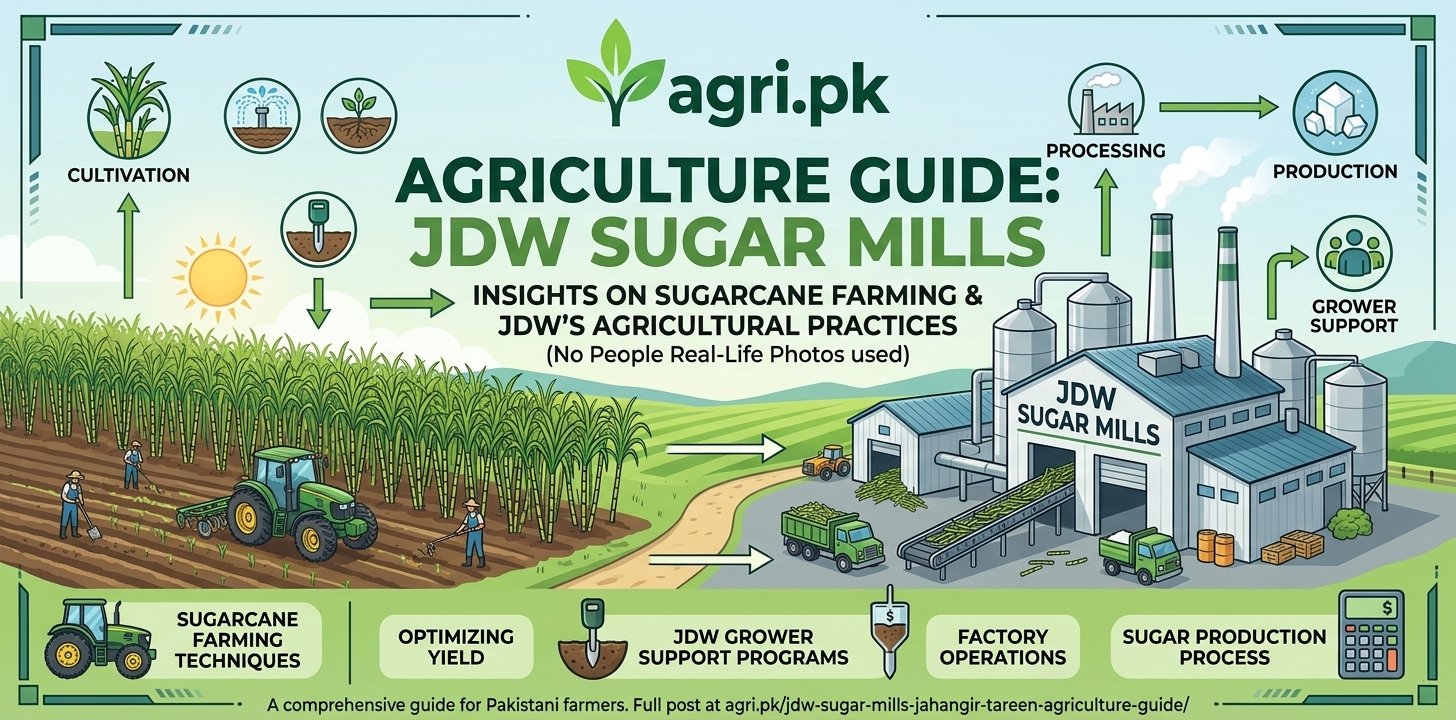
JDW Sugar Mills is one of the names every sugarcane farmer in southern Punjab and northern Sindh knows. Founded by industrialist Jahangir Khan Tareen, the JDW Group grew from a single sugar mill into one of Pakistan’s largest sugar groups, with its own sugarcane farms and a cane development programme that works with growers in its mill areas.
This article is not about politics. It is about agriculture: what a small or medium cane farmer can learn from how a large, organised sugar group approaches cane farming, and what parts of that model can — and cannot — be copied on a small holding.
What JDW actually is
According to the JDW page on Jahangir Khan Tareen’s own site, the Sugar Division of JDW Sugar Mills Ltd comprises three mills: JDW Unit-I, Unit-II and Unit-III, in the districts of Rahim Yar Khan in Punjab and Ghotki in Sindh, with a combined crushing capacity of 44,500 tonnes of cane per day. The same page puts the group’s share at approximately 15 to 17 percent of the country’s sugar production.
Alongside the mills, the group manages sugarcane corporate farms over a large area in Punjab and Sindh. That combination — mills plus their own farms — is unusual in Pakistan, where most mills buy almost all their cane from independent growers. It also means JDW has a direct interest in cane agronomy, not just in crushing: if the cane is poor, the mill’s recovery suffers too.
The lesson for a small farmer is not the size. It is the link between field and factory: cane quality is decided in the field, and it shows up in the mill.
Lesson 1: Cane development is a programme, not a slogan
JDW’s site describes an extensive community development programme aimed at increasing yield and profitability of small farmers in its area of operations, alongside education and health initiatives. It credits its Cane Development Program with doubling the per-acre yield of sugarcane in Rahim Yar Khan, and with lifting sucrose recovery in its operating area from 8.2 percent to almost 11 percent in 2016.
Those are the company’s own figures, and they are dated — they describe a particular period, not a guarantee for today. But the structure behind them is worth copying in miniature: a sustained programme, over several seasons, focused on variety, planting, crop care and harvest timing, rather than a one-season push.
For a small grower, the practical version is simple: pick a proven variety for your area, plant clean, healthy seed, and keep a record of what you planted, when, and what it yielded. Without that record, you cannot tell whether a new variety or a new practice actually helped.
Lesson 2: Variety and seed matter more than extra fertiliser
Sugarcane is a long crop, often in the field for a year or more. A wrong variety cannot be fixed later with extra urea. The varieties that perform in Rahim Yar Khan or Ghotki may not perform the same way in central Punjab or Sindh, because of climate, water, soil and disease pressure.
Ask your mill’s cane department, your provincial agriculture department, or a sugarcane research institute which varieties are recommended for your zone this season, and whether certified or clean seed is available. Planting seed from your own old, diseased crop because it is free is often the most expensive choice of the season.
Lesson 3: Recovery is where the money is
For a mill, sucrose recovery — how much sugar is extracted from each tonne of cane — is the key number. For a farmer, recovery matters indirectly but powerfully: mills prefer clean, mature, well-topped cane, harvested at the right time, because it crushes better and yields more sugar.
Practical points that help recovery, and that any farmer can control: harvest at maturity, not early out of anxiety or late out of delay; top the cane properly and remove trash and mud; avoid waterlogging in the last weeks before harvest where you can; and deliver promptly after cutting, because cut cane loses sucrose with every day it lies in the field, especially in heat.
If your mill gives you a recovery or quality report, read it. It tells you more about your field practice than the cane price alone does.
Lesson 4: Corporate farms are a laboratory, not a model to copy acre for acre
A corporate farm can afford laser levelling, mechanised planting, drip or improved irrigation, and full-time agronomists. A 5-acre or 12-acre grower usually cannot, and should not try to copy the whole package at once.
What can be copied is the discipline: soil testing before planting, a fertiliser plan based on that test rather than on habit, timely irrigation, weed control in the early months when cane is most vulnerable, and pest and disease scouting. One improvement per season, measured against your own previous yield, beats five changes made at once that you cannot evaluate.
Lesson 5: By-products and diversification reduce risk
JDW’s group activities extend beyond sugar into ethanol production and power generation from cane by-products. That is a factory-scale lesson, but the principle applies on a farm too: a farm that depends on one crop, one buyer and one price is fragile.
Cane growers in the same area often combine cane with wheat, fodder, or vegetables in rotation, or keep livestock for milk income between cane payments. Diversification does not mean abandoning cane — it means the household is not left with nothing while waiting for a cane payment.
What a small cane farmer should ask the mill
If you supply a mill, including a large group like JDW, ask these questions in plain words, and keep the answers in writing where possible: Which varieties are recommended for my area this season? What is the expected crushing schedule for my zone? How is cane quality assessed, and can I see my own quality report? What is the payment schedule, and who do I contact if a payment is delayed? A clear, written answer to any one of these is worth more than a verbal promise.
A note on sources and figures
Company websites are useful for understanding a group’s structure and its own claims, but they are not independent audits. Crushing capacity, production share, yield and recovery figures in this article are as stated on the company’s own pages, and some are several years old. For current cane prices, crushing schedules, variety recommendations and payment terms, always check with your mill, your provincial agriculture department, or the official notification for your area — do not rely on a blog post, including this one, for a price or a date.
Frequently asked questions
Is JDW the largest sugar group in Pakistan? By crushing capacity and production share as stated on its own site, it is among the largest, at around 15 to 17 percent of national sugar production. Exact rankings change with each crushing season.
Can a small farmer join a cane development programme? Programmes are usually run by mills in their own supply areas. Ask your mill’s cane department whether it runs a development, seed, or advisory programme for growers in your village, and what the conditions are.
Does higher recovery mean a higher price for the farmer? Not automatically. The cane price is set by official notification and market arrangements, but better quality cane is more welcome at the mill, less likely to be rejected, and more likely to keep a grower in good standing for the next season.
What should a new cane grower do first? Soil test, recommended variety, clean seed, and a written plan for irrigation, fertiliser and harvest timing — in that order. Everything else is refinement.
Sources
JDW page, Jahangir Khan Tareen official site: https://jahangirktareen.com/jdw
JDW Group official site: http://www.jdw-group.com/
If this guide helped you think about your cane crop differently, share it with a fellow cane grower — and let agri.pk know which mill, crop, or farming system you would like explained next, in plain words.